Breathless in the Hermit Kingdom
🗓 posted Apr 28, 2026 by Josh Erb🔢 2232 words
🏷 #life #travel #bhutan
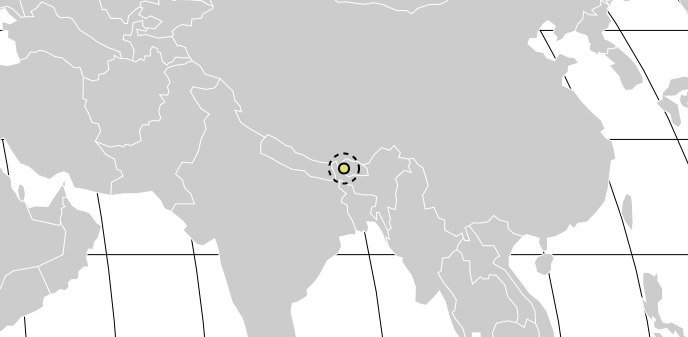
The flight into the Kingdom of Bhutan from Kolkata, India is brief, only a little more than an hour between lift off and the lurching shriek of rubber hitting tarmac. You ascend from the pollution and dank humidity of a high-density metropolis and the world transforms, impossibly, beneath you as you make your way to another plane of existence. The first indication that you are departing one reality and entering another, entirely different one is the mountain peaks that stab up through the cloud cover. Partway through the flight the pilot, a Bhutanese local specifically trained for this technically challenging itinerary, will turn on the speaker and indicate which of the hulking peaks is Everest. Intellectually, I knew that the mountain's summit rests serenely just a few hundred meters below cruising altitude.[1] Confronted with the physical reality of this fact when I looked out my window, however, I was left a bit dumbstruck. Despite myself I squinted to see if I could see small specs trying to make their way to the summit that morning.
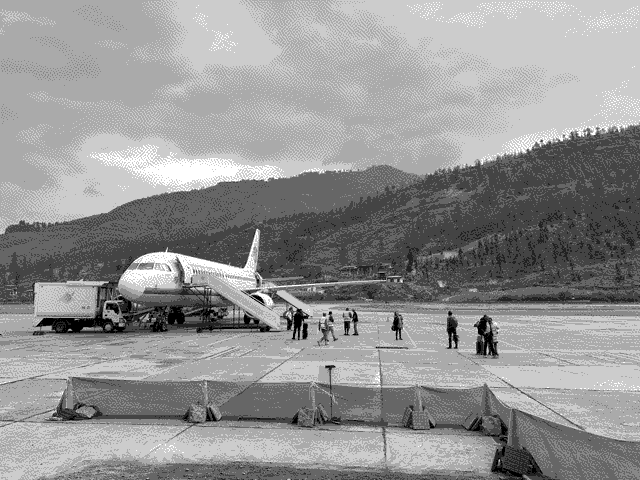
The approach for landing for the Paro airport is not a simple question of descent. The topography of the mountain kingdom obligates planes to wind an interesting path through the green mountains as they descend. At times the hillside and farmland feels far too close. Passengers might experience some subconscious anxiety that the pilot is not as technically adept as they had hoped. Like me, they might begin to suspect that some nefarious miscalculation has been made that will lead cause them and the other 180 or so passengers on your flight to crash into the terraced farmland that takes up all the view outside the plane windows, until suddenly the plane levels out, tarmac appears, and the wheels touch down in the tranquil Kingdom of Bhutan.
The airport in Paro is the only international airport in a country with a land area nearly equal to that of Switzerland. You deplane on the tarmac, but despite this, it's incredibly quiet. Only a handful of flights arrive and depart from the international hub each day. After so much time spent in clamor India, the silence that followed when the plane cut its engines was forceful.
A Bit of Background
If you were born in Europe or the United States and you are fortunate enough to be able to travel outside the borders of your homeland, there are very few sovereign nations you can visit that have not been touched by the necrotizing hand of a colonial legacy.[2] Bhutan is the rare, and in my case first, exception to this rule. The course of Bhutan's history, since around the 17th century or so, has been entirely self-determined. Anywhere that outside influence can be observed — English used in schools and widely spoken by the local population, Bollywood films on television, a South Korean restaurant in the country's capital, &c. — is the result of conscious decision to allow it.[3]
Several interactions enforced that there is a broad cultural awareness of this fact. While visiting a site, a member of our tour group mentioned in passing to a local guide, "You have a beautiful country," and the man just said, "Yes. We'd like to keep it that way."
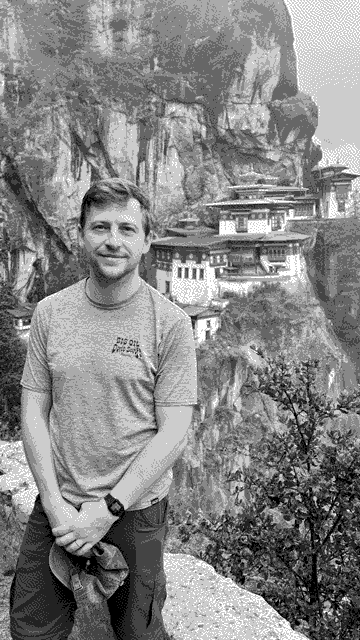
As we started our hike up to the Tiger's Nest, our guide paused at the trailhead to mention that the site and it's popularity is a good example of the adverse harms of tourism that the country hopes to avoid spreading to other sites. And he specifically meant the use of horses to hike up a portion of the trail for tourists, an activity which he considered to be counter to Buddhist teachings on the ethical treatment of animals.
Despite tourism being the second largest industry for the small country, they are acutely aware of the harms and pitfalls. I've mentioned before the uneasy feeling that necessarily flows from traveling to a place as a tourist. Bhutan is one of the first places I've traveled to that explicitly acknowledges this aspect of the relationship. Not to say that this made me feel any better about it, but it was a surprising departure.
The Trip Itself
This was my first trip in a while traveling without my family. I traveled with a group of American friends who all currently live in Mumbai. We were in Bhutan for 5 full days together. As part of Bhutan's "Sustainable Development Fund," all tourists pay a $100/day fee to the government for each day they spend in the country and are required to be accompanied by a tour guide and driver. While booking the trip we were moderately worried that this might give the whole tour the same atmosphere as a North Korean holiday. However, we quickly clarified with the guide that we were free to roam around unsupervised at various points. My understanding, developed over the course of our trip, is that the rule mostly revolves around helping visitors understand and respect the proper etiquette around visiting temples, monasteries, and government buildings. And more importantly, the driving in Bhutan is mountainous, winding, and conditions are challenging enough that having a local driver is an essential part of surviving the trip for foreigners.
It was a good group to travel with. We made it clear early and often, that we were more interested in eating local food than whatever stuff they expected tourists to prefer. This was a tip we'd had from a friend who traveled to Bhutan a few months prior. Because Bhutan cuisine frequently incorporates hot peppers as a main ingredient in dishes, you will either eat the fairly bland food they prepare for the benefit of tourists or spend your time exploring the upper end of the Scoville scale. Coming from Mumbai, we all felt fairly capable of spice, and the local dishes were well worth the pain. Some personal highlights were: all the different varieties of chili cheese, which consists of hot peppers sliced diagonally and sautéed with melted cheese; chili paste, which we described as "Bhutanese pico de gallo"; and a spicy Beef stew that had clearly been prepared for the guides and drivers, but which the restaurant owner shared with us after they assured her we could handle it.
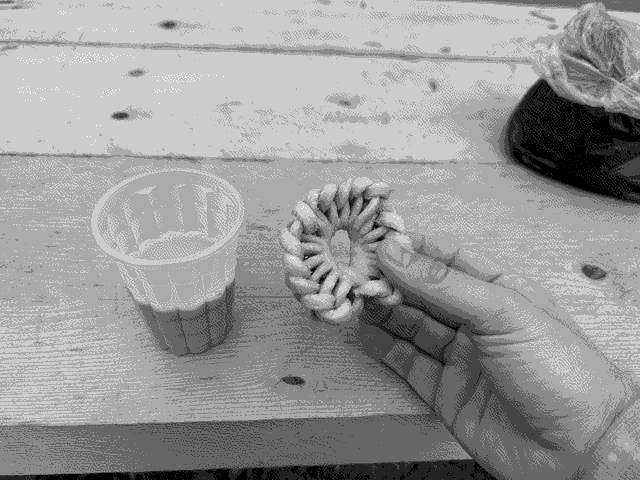
The day-to-day itinerary of the trip itself was centered around hiking and visiting temples and monasteries. On the second and third days of our trip we did an "easy" and "moderate" hike, respectively. However, because of the altitude — the third day's hike peaked around 3,900 meters above sea level — we were all severely unacclimated. When we reached the summit of the third day's hike, our guide produced a thermos of suja (Bhutanese butter tea) with toasted rice and a bag of handmade butter biscuits. As I caught my breath and began to shiver from the cold air blowing across my sweat drenched body, I finally understood why suja, an incredibly filling drink, was such a staple in the country.
I have only managed to hike one time since moving to Mumbai. So despite the light altitude sickness and the chilly weather, I woke up every day overjoyed that I would be able to spend some time walking around in mountain forests.
A Chance Encounter
There's one other thing worth recording for posterity. On the penultimate day of our trip, we did a small hike up to a temple on a hill that overlooked Punakha. We weren't in a hurry that morning as we made our way up the hilltop. The sun kept peaking out from the clouds and bearing down on us, so we stopped occasionally to drink water and wring the sweat out of our shirts and hats. As we neared the top, a local casually mentioned something to our guide in Dzongkha that made him stop in his tracks and turn back toward us. "The King and his mother are at the temple," he told us excitedly.
It turned out that the King and the Queen Mother, who had commissioned the temple in question and dedicated it to the longevity of her son, had made non-publicized plan to attend the final day of a 10 day Buddhist festival. So rather than a keep our visit to the temple short and then moving on to the rest of the itinerary, we sat outside the temple in the noon day sun for an hour and waited for them to appear. As we waited, monks appeared from within the walls and blessed our bowed heads with various auspicious relics that were housed within the temple.
When they finally arrived, the King and Queen Mother made it a point specifically to talk to the crowd of gathered tourists. There were many locals there, but they were content to merely witness the King as he walked by and instead hung back behind the tourists. The implication was clear — at least to my mind: the royal family recognizes the importance of the tourist industry to the country's economy, and feels it would be a breach of good manners to ignore those guests who have come to experience their great country firsthand.
When the King came to our group, he asked how our visit had been so far. We said it had been great and we were honored to be in Bhutan. The Queen Mother asked us where we were from and when we replied The United States of America, she urged us to "please pray for everyone." The comment was likely related to war with Iran, which hung over the whole week we were there. As our guide mentioned, the tourist season had dropped off earlier than expected because commercial flight itineraries from Europe and the US are typically routed through Dubai.
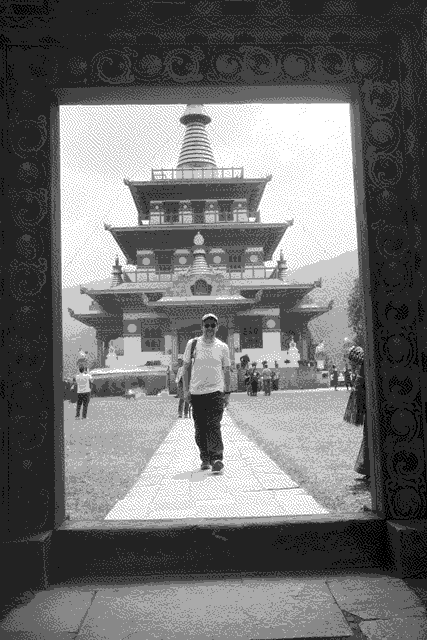
The King's security made it very clear that we were not allowed to take any pictures of the interaction. But as we waited for the royals to finish their participation in the day's ceremony, members of the King's staff handed out free mango juice boxes to the gathering crowd. My only picture to mark the occasion is a candid that my friend took as we were leaving the temple.
Enthusiastically Ambivalent
Bhutan certainly made an impression, but I can't shake the feeling that I should loathe the country. On paper, at least. It does not align with my values or the principles I like to think I live by. It's a hereditary monarchy. Its democratic institutions were not hard won by a people yearning for liberty, but rather were granted by a benevolent king who believed his people had demonstrated that they were ready for democracy.[4] Religion and statecraft are linked in innumerable ways, with Buddhism serving as a pillar within the government institutions, subject still to the King.
Despite all of this, though, it was maybe one of the best countries I've ever visited. Maybe all the fresh air and altitude went to my head, I don't know. Everyone we met during our week in the western regions of the country was kind, even the police officer that yelled at us for behaving like Mumbaikars and crossed the street without a crosswalk in Thimphu. The air was crisp and clean. The food was fresh. Rhododendron flowers bloomed alongside the trails and spilled down the sides of the mountains as we hiked.
Our final morning in the country we stayed at a resort within view of the airport in Paro. It's one of the busier parts of town, but the only thing I heard as I sat on the balcony of my hotel room that final morning was the babble of the river that ran nearby. As I get older, it's increasingly clear that we understand the places we visit only in relation to other places we have been. Maybe this is what the incessant din and oppressive summer heat of Mumbai has taught me most of all, how quiet and sublime other parts of the world can be.
Average cruising altitude for a short leg commercial flight is a little over 9,000 meters above sea level. Most recent measures of Everest put it's height at around 8,850 meters from sea level.
I'm not really counting the Treaty of Punakha with British India because, as I understand it, Bhutan was so self-isolationist at the time that giving another country control over its foreign relations was basically an elaborate practical joke.
My first drafts of this section all included comparisons to how Amish communities in America approach adopting different countries, but I scrapped them because it felt like it muddled the point rather than clarified it.
Also worth noting that these reforms happened as recently as 2008. My high school diploma is older than Bhutanese democracy.
<< all notes.