The Books of Jacob
In 2025 I read The Books of Jacob by Olga Tokarczuk.
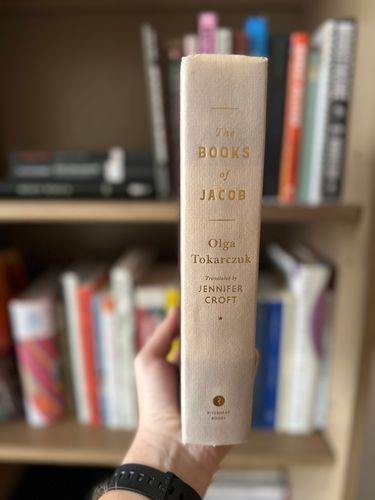
Timeline
- Oct 20, 2025: started reading.
- Dec 16, 2025: finished reading.
Review
Being married into a Polish family, I have been aware of and very much in awe of Tokarczuk’s work for the better part of the last decade. Flights was a great introduction. By the time I got to Primeval and Other Times, she had fully and irrevocably sunk her curious little hooks into my brain.
That being said, though, I was not keen to pick up this nearly 1,000 page tome until I happened to read this essay from her translator, Jennifer Croft, who spent the better part of a decade painstakingly translating the book into English. Croft is the best kind of translator an author could ask for: reverential and devout. Needless to say, I don’t regret the decision to pick it up.
Enlightenment begins when people lose their faith in the goodness and the order of the world. The Enlightenment is an expression of mistrust.
— p130
Tokarczuk is meticulous in her exploration of the themes, characters, events of her chosen subject. It’s one of those rare books that feels like it contains an entire world, fully realized.
You might be tempted, at first blush, to assume that the titular character, Jacob Frank, is the protagonist of this sprawling novel. After all, he is a mysterious 18th century Jewish mystic who claims to be the Messiah and gathers around him a congregation of true believers from the scattered nations and tribes of eastern Europe. But Jacob’s true beliefs, intentions, and motivations are never examined. In fact, in this expansive book he is the one character who’s interiority we are never permitted to see. And so, after a few hundred pages you begin to realize that this inscrutable messiah and the winding journey he and his sect take through pre-modern Europe are the means to contemplate something bigger, something almost inexpressible.
Each character, no matter how minor, is treated with the utmost care and attention. Many of the more prominent ones serve to contrast and highlight the features and beliefs of others. Some characters are setup as foils, Molwida, a nomadic Polish Noble who serves as a translator and secretary for the fledgling cult, is an incredible counter point to Nahman, one of the first and most faithful believers in Jacob’s purpose and destiny. In the margins, a polish priest tireless edits his proto-encyclopedia and dreams of having all knowledge organized and accessible to anyone who wants it. He corresponds with a poet who tells him that literature is “the perfection of imprecise forms.” These are just four examples from a cast of countless more.
Taking a step back to look at the whole, the fate of the Frankists serves almost like an elaborate frame that guides your eye deeper into a baroque landscape. The narrative takes in the full scenery of the cities, nations, and peoples of the 18th century as they convulse and transform into something different. In this book you find Reason in tension with Faith, history serving as myth, truth underpinned by the lies we must tell to understand it. At the end of your long wandering, as Tokarczuk’s omniscient narrator looks down curiously on her writing the final words, you come to realize that this book is about us. About the countless, invisible ways in which we have been shaped by the alien and forgotten forces of our past.
A demanding novel, to be sure, but well worth the effort.
Details
- Publisher: Riverhead Books
- Page Count: 965
- ISBN: 9780593087480
<< shelf.