Why the Poor Don’t Kill Us
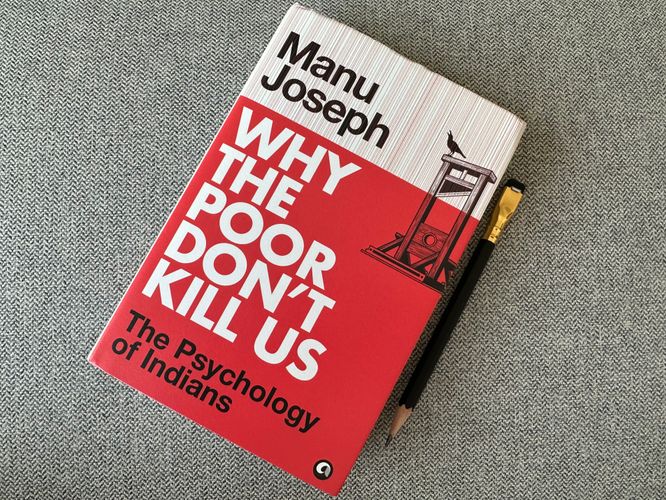
In 2026 I read Why the Poor Don’t Kill Us by Manu Joseph.
Timeline
- Feb 10, 2026: started reading.
- Mar 02, 2026: finished reading.
Review
This was recommended to me by a neighbor. Its provocative title and promise of helping me better understand the social structures in contemporary India piqued my interest enough to pick up a copy.
Joseph has a fair amount of insight to offer. One particularly compelling point that felt new to me is his idea that the chaos of public infrastructure in the country plays an important role in preserving the social hierarchy that exists. He writes:
India’s public chaos, like its architectural ugliness, convey to the poor that the nation is something like them — poor.
[p56]
The book is written in a provocative, polemical tone. Often making a given point with its tongue firmly planted in its cheek. While this might be good for selling books in airports, it’s an unfortunate choice because — to my ear — it undermines the credibility of his assessments and the force of his later arguments. It also feels like a tonal choice that someone who lacks the courage of his convictions might make. Maybe I’m missing something. Maybe in India this is the only way to write a book addressing this topic without being burned at the stake. For me the tone became grating by about page 100, and the remaining 166 pages were much less interesting as a result.
I’ll say it again, I think the tone served to mask some insecurities about his own arguments. His analysis in several areas was sharp, but flippant. In many cases arguments were presented without enough evidence to justify the pose. He quotes his own writing several times, uses anecdotes from journalism work he did two decades ago to justify entire chapters, and seems to be begging the question for several of the arguments.
To add to all this, the book really falls flat on its face when Joseph shifts from analysis to recommendation in the end chapters. It’s clear he has a shallow view of history and a cynical view of the possibility of change. After spending hundreds of pages describing the misery and chaos of his home country, he abruptly segues to “non-profit work is hopeless and the youth should focus on making money so they can be better philanthropists” and “we need to establish a culture of tipping for service.”
I am very much an outsider here. I understand that. I won’t try to make my own diagnosis or prognosis because it would not be well informed. But what I can say is that this book, which seems to want to say something sharp and insightful about the state of this part of the world, is cynical and not rigorous enough in its thinking to have earned its final, hollow pot shots.
Details
- Publisher: Aleph Book Company
- Page Count: 266
- ISBN: 9789365234572
<< shelf.