The Dream Songs
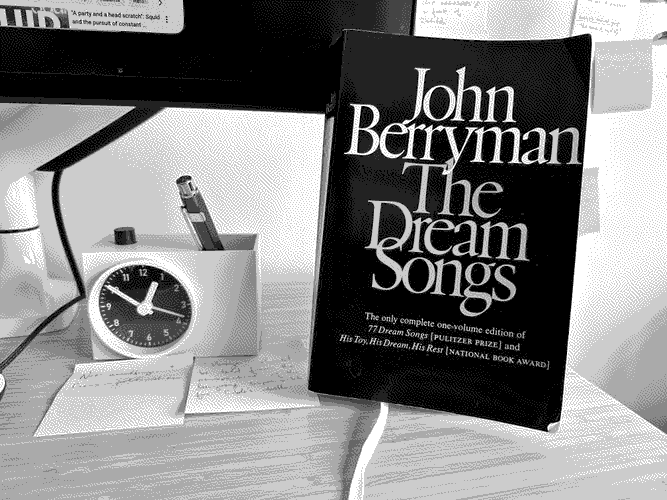
In 2026 I read The Dream Songs by John Berryman.
Timeline
- Jun 12, 2026: started reading.
- Jul 16, 2026: finished reading.
Review
I can still remember the moment freshman year of college when a friend showed me the YouTube video of John Berryman reading Dream Song 14. I hadn’t previously encountered poetry that felt so chaotic and alive. So idiosyncratic in voice and mannerism. Once you’ve heard Berryman do a reading, it’s hard to hear the songs in any other way.
Sometime after I saw the video. After college, certainly, I found this collection and bought it secondhand, I think (maybe) from Second Story Books off Dupont Circle in DC. Previously, I’ve used this book as a reference, opening it up and flipping to a Dream Song I already know. Maybe lingering over an unfamiliar one if it catches my eye. Never a sustained linear effort.
Time passes and tastes change, though. Recently I found myself wondering if I actually liked Berryman’s verses, or if I was just feeling nostalgic for the feeling of being young with an undiscovered world of thought and experience unspooling out ahead of me. And so, one thing leading to another, I’ve finally found the time to read through the whole collection. All 385 of the original Dream Songs.
In slack times visit I the violent dead
and pick their awful brains[…]
[DS 88]
Reading through it from 1 to 385 for the first time, I realized this was always the intention. As one critic recently put it “The Dream Songs is, as mentioned, an epic, one that largely takes place in the living rooms, restaurants, bars, and campus offices of jittery postwar America” (source). Only by reading linearly can you see how the individual poems are in dialogue with one another, repeating themes or references or turns of phrase.
That being said, the original 77 are still the most compelling to my ear. The Dream Songs that Berryman wrote after receiving the Pulitzer Prize feel a bit tedious, a bit too haphazard self-conscious about the confessional style. I agree with the critic William J. Martz when he said that “Berryman made a serious mistake in not culling the Dream Songs more carefully” (source). Especially in Dream Songs 78 – 385, you have to sift a lot of dirt to find the flakes of gold.
Fortunately I’ve read a bit more broadly between my first encounter and this full read through. I more easily understand now the purpose of the avatar “Henry” for Berryman. He’s working in a similar vein to Olga Ravn in My Work. Only able to write about things that are too deeply personal, too traumatic, by inventing a character and creating an ironic distance. The poet himself confirms this in an interview from 1967, albeit obliquely and in regards to the work of Stephen Crane.
Similarly, I still find the use of “blackface” and Black modes of speech throughout the Dream Songs to be “uncomfortable” at best. However, I think there’s more to it than that if you scratch the surface. Specifically in its connection to American minstrelsy and the unresolved contradictions of the American Dream at the time these poems were written. Revisiting these discomfiting verses now I was reminded of Bill Orcutt’s exploration of the America’s uncredited cultural inheritance from these minstrel shows for his album A History of Everyone.
John Berryman’s is a frustrating and idiosyncratic voice. I don’t think it strikes the emotional chord in me as strongly a decade and a half after my first encounter. But nevertheless, there are lines in here that I’ll always carry with me.
A best word across a void makes a hard blaze.
Henry reacted like a snake to praise,
he shed his skin
appearing thenceforward in a new guise
so the praise was for his past, not he therein,
saving him from vanity, the mirror’s eyes,
[DS 287]
Details
- Publisher: FSG
- Page Count: 427
- ISBN: 374516707
<< shelf.