Hav
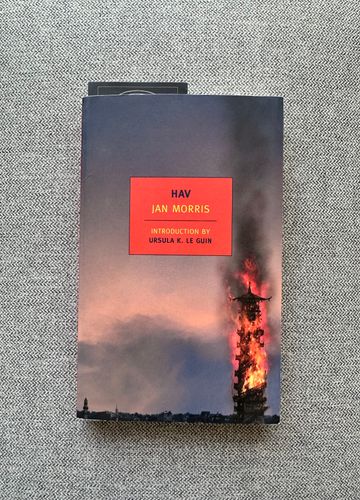
In 2026 I read Hav by Jan Morris.
Timeline
- May 21, 2026: started reading.
- Jun 04, 2026: finished reading.
Review
In my Junior year at the University of Illinois I took a class on Minority Languages which explored the cycles and histories of minority languages and the nation-state projects which hampered, suppressed, or allowed them to flourish. Toward the end of this class, students were split into groups and asked to invent a nation-state with a dominant and minority language and present it to the class. It was a fun project. My group invented an Island nation named “Tirnanog” roughly the shape of Guam and situated just Northwest of the Bay of Biscay. I’ve lost the presentation and I’m hazy on details, but I seem to remember the language being a blend of Icelandic and Irish Gaelic because of two competing settlements, but I digress.
Jan Morris’s unconventional novel about an imagined city-state reminds me a great deal about that project, though her ideas are much more mature and better realized on the page than our hastily thrown together presentation was.
Often times the hardest fiction to write convincingly is also the most mundane. George Perec’s Life: A User’s Manual, for example, has stretches of incredible tedium where he describes comprehensively the contents of drawers and objects littered across desks within a room. It’s only when you step back and recognize that the author has had to invent every detail that you begin to feel a profound appreciation for the depth of their invention. So too it is with Hav. Morris writes her fiction with the detail and authority of historical fact, which can make the book feel a bit dry at first, but then more impressive as the continuity and breadth of her invention unfolds.
Hav is, as she admits in the book’s Epilogue, an allegory. It represents a conjunction of civilizations, languages, and histories. An overly simplified summation would be to call it an exploration of the “East vs. West” narratives that popped up in the late 80s and have only accelerated in the intervening years. But there’s more to it than that. In fact, many of the descriptions, evasions, and attitudes featured throughout this book brought to mind James Scott’s Seeing Like a State. I think that Hav makes a great companion to that work, and it illustrates some of Scott’s ideas fairly deftly. In particular, the contrast between her initial description of the traditional Roof-Race compared to her disappointment with the artificiality of the constructed track and the campaign of entering the event into the Olympics.
I do think that the work is improved by the addition of the second, shorter visit to Hav. Morris added this section 20 years after the first novel’s release to commemorate its re-issue by New York Review Books. While there was a lot to chew on in the first section, the revisiting of the place and the contemplation of the forces that had shaped — that continue to shape — the country she is trying to understand gave it a complexity that I found much more satisfying than it had just ended on the ominous note of the original novel. The contrast between a country weighed down and complicated by centuries of overlapping history with a theocracy in the thrall of capitalism was keen-eyed and prescient. It called to mind my recent visits to Dubai and Oman.
Not bad for a book I initially picked up because I thought I might learn a few things about what makes for effective travel writing.
Details
- Publisher: New York Review Books
- Page Count: 301
- ISBN: 9781590174494
<< shelf.