The Idiot
In 2026 I read The Idiot by Fyodor Dostoevsky.
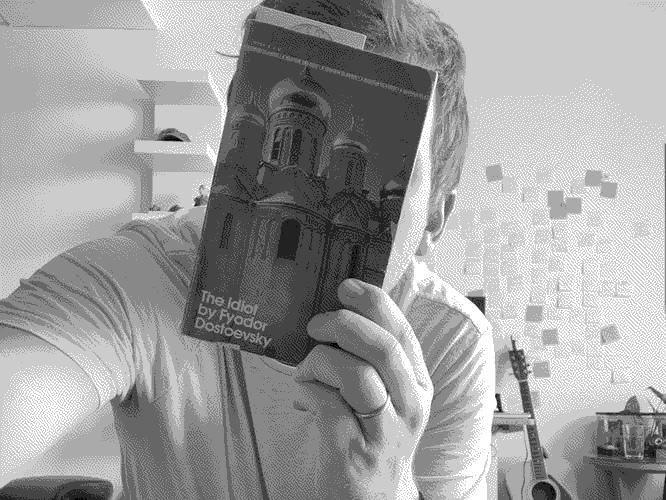
a picture of 'The Idiot' by Fyodor Dostoevsky in situ.
Timeline
- Aug 24, 2026: started reading.
- Sep 28, 2026: finished reading.
Review
This book was a detour during my reading of John Berger’s Portraits. Berger had mentioned a specific scene where Myshkin encounters a reproduction of Hans Holbein’s The Body of the Dead Christ in the Tomb and it sounded remarkably similar to a scene I’ve been struggling with in my second novel’s manuscript.
This was also my first Constance Garnett translation of a Dostoevsky novel. Years and years ago, when my parents moved out of my childhood house, I swiped this ancient mass market copy from a pile of my sister’s books that were going to be donated. I’m glad I did, when I reached for the book last month it almost felt like fate.
The prose of this novel was definitely much smoother than The Brothers Karamazov. So, despite my not knowing Russian, I am inclined to agree with accusations that Constance has smoothed out the wrinkles in Dostoevsky’s writing. Having now read different translators of the venerated novelist, it becomes more possible to (albeit imprecisely) intuit which parts of the novels are Fyodor and which parts are the translator’s own aesthetic preferences seeping into the text.
That being said, and despite Ms. Garnett’s efforts, characters still “seem” certain ways instead of simply being and they are often described as “almost” appearing or doing something. It’s incredibly tedious to read a book that’s 600 pages long and know that it would probably be closer to 500 if you removed every instance of those two words.
As far as the novel itself goes, I would certainly rank it below The Brothers. This seems to be Dostoevsky at his most reactionary and conservative. Whereas the moralizing is more successfully counterpointed and ambivalent in The Brothers Karamazov by the titular brothers Alexie and Ivan, in The Idiot it’s heavy handed and preachy. Dostoevsky’s working with archetypes and waxing poetically on the higher merits and tradition of Russian orthodox Christianity. He’s using a pure, innocent soul to hold a mirror up to the shallow vanity of the higher classes scheming. He’s hammering the point, again and again, about how corrosive modern attitudes can be to the health of society. Maybe it was original in the 1860s, but it’s all a bit on the nose for me here in 2026.
Now that I’ve read 3 of his novels by 3 different translators, I can more confidently say that his plots are shaggy, his characters are erratic and inconsistent, and his prose style leaves a tremendous amount to be desired — regardless of any valiant, but methodically dubious, “smoothing” efforts on the part of his English translators.
And so I find myself wondering why I keep reading Dosteovsky even though his style is so grating and his books are so long. Near the end of this book, I realized that his work evokes similar feelings to the ones I’ve had reading Knausgaard’s more recent novels (not his self-indulgent autoficiton, but his more recent apocalyptic trilogy; cf. The Morning Star). Ultimately it comes down to my fascination with watching another mind grapple with life’s biggest questions. What does it mean to be a good person in a corrupt society that privileges vanity and nihilism? How can a man live a good life despite the countervailing forces inherent in modernity? When an early nation-state begins to modernize is it a sign of the coming of the Christian apocalypse?
For both Knausgaard and Dostoevsky, I don’t necessarily agree with the conclusions they gesture toward and I certainly don’t always find their methods of analysis satisfying or comprehensible, but I relish bearing witness to the struggle they’re engaged in.
I am glad I read the book. I think the scene with Myshkin and Rhogozin standing in front of Holbein’s painting is a valuable reference point for my own work and I’m grateful to Berger for making the connection in his writing.
That being said, I’m afraid to admit that I would have been among the many contemporary critics who panned this book when it was first published.
Details
- Publisher: Bantam Books
- Page Count: 597
- ISBN: 553211366
<< shelf.