The Möbius Book
In 2026 I read The Möbius Book by Catherine Lacey.
Timeline
- Jun 05, 2026: started reading.
- Jun 11, 2026: finished reading.
Review
When an author experiences a profound change in their lives, it is not unusual for them to turn to writing as a means of understanding the shift. Writing is, after all, a tool for organizing and interpreting the chaos that surrounds us as we navigate the world. Unfortunately in most cases, the choice to publish the writing that results from this process is a mistake — unless your name is Olga Ravn.
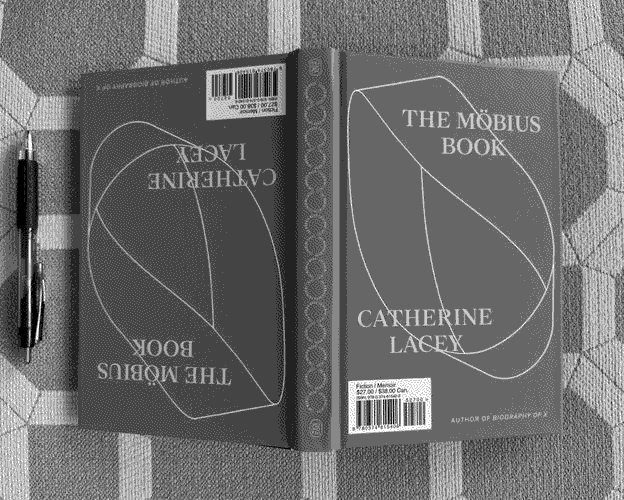
Catherine Lacey’s book has all the right ingredients, if we can believe the copy on the dust jacket, for a compelling exploration of this period of her life. She’s a lapsed Christian who was recently broken up with by her longterm partner. A partner who, she realizes in hindsight, had taken the place of Jesus as her personal savior. The fulcrum of her unarticulated faith has vanished unexpectedly, and she’s not sure who she is. Even more tantalizing, the book is organized around an unconventional metaphor for the act of writing stories to make sense of life. The metaphor of the Möbius strip is used to justify the book’s uncommon physical structure. You can start reading from either end, depending on your choice you will begin with fiction or non-fiction. At a certain point, you will have to flip the book over and around and start reading it from the other end until you meet in the middle.
As the blurb says:
“A hybrid work with no beginning or ending, readable from either side, The Möbius Book troubles the line between memory and fiction with an openhearted defense of faith’s power, and inherent danger.
And yet, for some reason which is both expressible and inexpressible, it all falls flat. (I know that this previous sentence’s interjection is grating and adds nothing to the argument, I am taking a petty jab at the heavy-handed, aphoristic prose that creeps in throughout the book.)
My knee jerk criticism of this book is that it is basically “Eat, Pray, Love” for people who spent their young adult lives on Tumblr. But that’s reductive and needlessly mean-spirited. So I’d like to try to understand why a book which is so compelling in its premise ultimately fails to deliver on its promises. For me it comes down to three major flaws.
First, and most glaring for me, was how underdeveloped the central metaphor of the book is. You might assume that titling the book after this metaphor and structuring the book itself around your own understanding of the metaphor should mean that the metaphor is well articulated and compelling somewhere in the pages, even if only between the lines. You would be wrong.
Writers, and I know I am guilty of this myself, which is perhaps why I’m sensitive to the tendency, often succumb to the impulse to reach for complexity when simplicity would have been more effective. This tendency grows from an anxiety that their insights be too simplistic or facile if they are not associated with something more abstruce. In the case of this book, the only place in the text where the metaphor is addressed explicitly is this line in the non-fiction section:
It was hard, we agreed, to find satisfying conclusions to stories that weren’t exactly stories but rather a set of prompts that resisted completion, a Möbius strip of narrative.
— p118 (non-fiction section)
Astute readers will notice that she could just as easily be describing a circle. But that shape is too simple for her to be considered a “serious” writer. Naming your book “The Circle Book” just wouldn’t rise to the height of literary erudition to which this book aspires.
Ironically, the idea to compare written works to Möbius strips is not a novel one. However, the defining feature of this geometric form is that it is “non-orientable” meaning that within its plane you cannot tell which direction things are facing and if they travel along the plane long enough they return to the same position but are inverted.
A comparable effect is certainly achievable in fiction, and Lacey makes some vague gestures in its direction by including details from the non-fiction in the fiction, but on the whole these little details are sprinkled in rather than used as anchor points. In the end, she does so little with it that it’s hard to believe she explored the concept deeply enough to employ it in the work’s structure. I think if she had we would never be quite certain if we were reading fiction or non-fiction and images and moments would be inverted and repeated as the story progressed. But because of her choice to write the non-fiction in a confessional mode, and compounded by the structural choice to split the two sections in half and point them at each other in the middle, the metaphor and the structure just don’t amount to anything quite as insightful as one would hope. A better metaphor might be two parallel lines pointed toward the horizon, converging on some unreachable sense of self that lies an infinite distance away.
The second flaw is Lacey’s own unchecked egotism in the non-fiction section. I understand that if you write a book about your life it will be mostly told from your perspective and heavily biased toward your own experiences as a consequence. However, the rhythm and structure of her non-fiction is such that different segments of it are literally just her friends and acquaintances sharing horrible things that have happened to them and Lacey finding ever more elaborate ways to make it about herself. I am not exaggerating when I say that at one point she describes a childhood friend slowly going blind over the course of their friendship because of a genetic condition, but then, bafflingly, she ends the story with an anecdote about a moment where he tells her “you are so easy to love” and it comforts her. Again, if you’re writing in the confessional mode, I understand that there is an unavoidable amount of solipsism, its presence in the book is not surprising. What is surprising is that it’s not clear that she is aware of just how glaring it is. She’s just been through a horrible breakup. Her sense of self has dissolved. Other people’s suffering only exists to help her think about her own.
Finally, the book’s content is overly reliant on the reader’s awareness of a catalogue of meta-textual background information. If you hadn’t listened to any of the interviews that Lacey has given to accompany the book’s release, then you wouldn’t know that her ex-partner — who she cloying refers to as The Reason throughout the non-fiction section — is Jesse Ball and that this book is like the literary cool kids equivalent of a Taylor Swift breakup album. You also wouldn’t know that in the wake of this breakup Lacey moved to Mexico City. This is alluded to in the non-fiction section. The fiction section might take place in Mexico City, because there are some touchstones like mezcal and unnecessary use of the word “caballitos” when they drink it, but it’s never addressed and doesn’t quite make sense in the context of the story.
I have many other quibbles. Some at the line level and some with her choice of which stories within the narrative are interesting. But there’s not much value in enumerating them here.
I really wanted to like this book, but as I finished the non-fiction section and was faced with the two blank pages that signal the end of one section and the beginning of the other, I had to take a beat and persuade myself that it was worth finishing the book.
In this context, I’m forced to conclude that Lacey is an author who writes without understanding and hopes that meaning will happen in the process. Not an inherently bad approach to craft, but when meaning fails to materialize you are left with the literary equivalent of a bag of cheese puffs. Fine enough to eat, but ultimately not much more than air and artificial flavoring.
Details
- Publisher: FSG
- Page Count: 218
- ISBN: 9780374615406
<< shelf.