The Rebel
In 2026 I read The Rebel by Albert Camus.
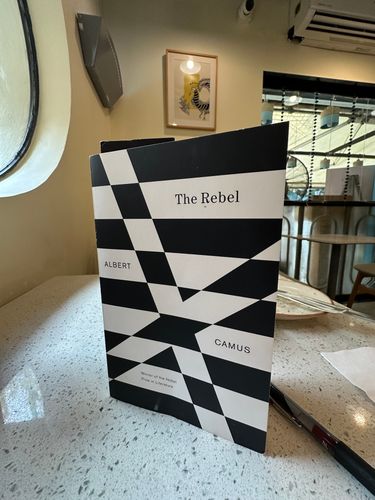
Timeline
- Nov 16, 2025: started reading.
- Jan 08, 2026: finished reading.
Review
Well worth the cost of ending his friendship with Jean-Paul.
Several times while reading this book, I had a hard to describe experience. As if I could clearly grasp all of the eddies and currents of the history of western philosophy over the last 250 years. Something like hovering over the knotted stream of time and being able to see the whole field of play as its rapids wind through the valley of history to flow into the present.
The Rebel is not a rigorous work of philosophy so much as it’s a collection of evaluative essays that look at philosophy and history through the lens of sociopolitical rebellion. The first three quarters of the book do a really fantastic job of demonstrating a deep understanding of different philosophical projects, most notably those of Marx and Nietzsche, and adeptly highlighting both their motivations and their shortcomings.
I’m probably primed more than most to agree with Camus’s assessments in several of these areas. Particularly because of his emphasis on revolutionary trade unionism and the rebellion inherent in the art of the novel. That not withstanding, though, there are some things that Camus got right from the jump, e.g. a critical view of Lenin’s emphasis on the necessity of violent repression after the revolution and Nietzsche’s strength as a thinker well adept at diagnosing the philosophical sickness of the age, but a pretty disastrous prophet. And plenty of stuff that’s a bit embarrassing in hindsight, i.e. the claim that dialectical materialism’s inevitability of revolution has been adequately kept in check by the gains made by labor unions (O Tempora, O Mores!).
A little bit of research confirms that this wasn’t meant to be a philosophical treatise of rebellion. Camus himself said that these essays were more a means of organizing his thoughts around a given subject for his other projects than a fully formed theory.
But this was my first encounter with Camus’s non-fiction. He writes well, even in translation which is well-known to sanitize & standardize a writer’s native style. I’ll leave you with one of the countless great lines the drops throughout the 300 pages:
Martyrs do not build Churches; they are the mortar […]
— p 172
I’ve got a copy of The Plague in the original french (”La peste”) sitting on my shelf staring at me. This might be the thing that pushes me to finally pick it up this year.
Details
- Publisher: Vintage
- Page Count: 306
- ISBN: 9780679733843
<< shelf.