After Virtue
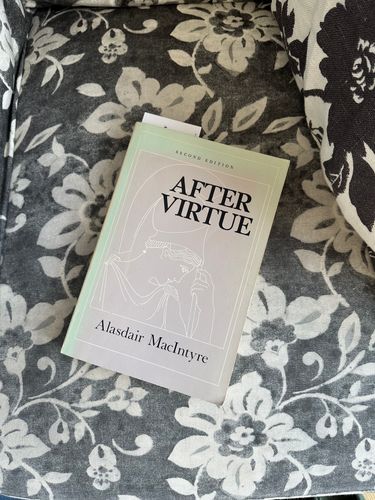
In 2026 I read After Virtue by Alasdair MacIntyre.
Timeline
- May 17, 2026: started reading.
- Jul 02, 2026: finished reading.
Review
When I buy a book secondhand, I sometimes like to tuck the receipt into the front cover and leave it there as a sort of memento. This peculiar habit is why I can tell you that I picked up my copy of this volume on July 4, 2015 for $1.41 (USD) at the Georgia Avenue Thrift Store in Washington, DC. I had just moved to DC from Chicago the previous September after completing my master’s degree and I was drawn to the book because I remembered someone in a political theory seminar mentioning MacIntyre’s work as a compelling counterpoint to Richard Rorty’s political writing on liberalism and irony. At the time, I was still laboring under the delusion that I might work for an NGO or a think tank in an area related to my academic degree or intellectual interests. I paid for the book with a credit card, even though my total bill was $2.19 (USD), because paying monthly rent and student loans with my internship’s $10/hour pay meant each non-essential transaction I made throughout the month was a tiny prayer that I would have the money by the end of it.
We live out our lives, both individually and in our relationships with each other, in the light of certain conceptions of a possibly shared future, a future in which certain possibilities beckon us forward and others repel us, some seem already foreclosed and others perhaps inevitable. [— p215]
In Ian Shapiro’s online lectures (see “Contemporary Communitarianism” part I & part II) he labels MacIntyre’s project as “Anti-Enlightenment.” And this helped me to locate what about the argument felt so compelling, and where it overlapped with Rorty’s critique of Enlightment (ref. Philosophy and the Mirror of Nature). Similarly to how Rorty dissected and dismissed the philosophical project of trying to reason from first principles, MacIntyre’s book provides an honest assessment of the flawed premises and failures of the Enlightment with regard to establishing a rational moral framework. These historically-grounded assessments will never stop being compelling to me. I couldn’t help thinking of this line from Tokarczuk’s The Books of Jacob:
Enlightenment begins when people lose their faith in the goodness and the order of the world. The Enlightenment is an expression of mistrust. [— Books of Jacob, p130]
MacIntyre’s argument is rigorously structured and nuanced in a way that resists a quaint little review for a personal website. His core premise — that all contemporary moral philosophy is built on the misunderstood scraps and ruins of the classical framework of the virtues — was a cogent and overall convincing diagnosis of the incoherence of the present age. His proscribed response to this, i.e. a neo-Aristotelian reaffirmation of tradition and community, makes sense within the context of his argument, but isn’t something I’m ready to accept wholesale. But this doesn’t bother me, I’m sure these are arguments and concepts I’ll return to with more or less credulity in the coming years.
I’ll content myself with jotting down some quick highlights. The structure of his argument, starting from contemporary moral philosophy and working backward to Aristotle, worked well. It’s hard to think of a better way to argue the point.
Notably, Chapter 8: “The Character of Generalizations in Social Science and their Lack of Predictive Power,” was a great critique of the historical practice and trajectory of the social sciences. I was pleasantly surprised to have it affirm and articulate several points I had been grasping for in previous fiction-writing I’ve done.
I was also delighted to stumble across, in his articulation of the conception of what constitutes a “practice,” what I consider to be a rather effective rebuttal of the current generative AI fever dream we’re living through:
In other words we have to accept as necessary components of any practice with internal goods and standards of excellence the virtues of justice, courage and honesty. For not to accept these, to be willing to cheat as our imagined child was willing to cheat in his or her early days at chess, so far bars us from achieving the standards of excellence or the goods internal to the practice that it renders the practice pointless except as a device for achieving external goods. [— p191]
There are a lot of specialized terms specific to the vocabulary MacIntyre develops for his argument in the above quote, but it boils down to the fact that a mechanism which allows people to participate in the practice of some game or skill without requiring them to submit to or embody the values inherent within the tradition of that practice (i.e. painting a portrait without having to learn and refine the skills required like proportion, composition, foreshortening, or color theory) necessarily robs the practice of its intrinsic value.
All in all, lots to chew on in this dystopian work of moral philosophy — note that I haven’t even mentioned the concluding paragraph and its prescient forecast of the present political doom spiral — and, like I said earlier, I’ll probably be metabolizing its for many years to come.
Details
- Publisher: University of Notre Dame Press
- Page Count: 286
- ISBN: 268006113
<< shelf.