Explaining Death to a Toddler at the Taj Mahal
🗓 posted Apr 01, 2026 by Josh Erb🔢 880 words
🏷 #life #travel #india
Bad Guests
On a recent weekend my family and I traveled to Delhi and Agra. This was a trimmed down version of a "Golden Triangle" tour. As my wife and I planned it out we jokingly started calling it the "Golden Line" itinerary because we quickly decided to skip Jaipur. We did this because we were traveling with a toddler.
Traveling in India is hard. It's hot, bumpy, and always takes an hour or two longer than you expect. The thought of that much driving and stopping and trying to keep our son entertained and pacified exhausted us. So we worked with a tour company to plan the trip, they initially sent us a packed itinerary and talked about "the trip of a lifetime." We quickly put an end to that and had them cut almost everything except a few essentials and made them promise to only make us get out and walk around one major landmark each city.
I hope you'll believe me when I say that I love to travel and experience history and culture firsthand. My wife does too. I don't think we'd be where we are in life if we didn't. However, I don't love holding a wriggling, sweaty, and impatient 3 year old while a tour guide repeats dates and historically dubious anecdotes[1] at me.
We've had to come to terms with the reality that, at least for the next few years, we will be bad guests in any city or country we visit. We'll only want to see a few things and probably won't remember anything a guide tells us. We've learned to own the fact and allow it to guide our trip planning.
India and a Legacy of Broken Symmetry
The main reason for this trip was to see the Taj Mahal. We'll be leaving India in October and agreed we would be disappointed if we left without seeing it. We woke up before the crack of dawn, toddler in tow, and arrived at the Taj just as the sun was beginning to light up its eastern wall.
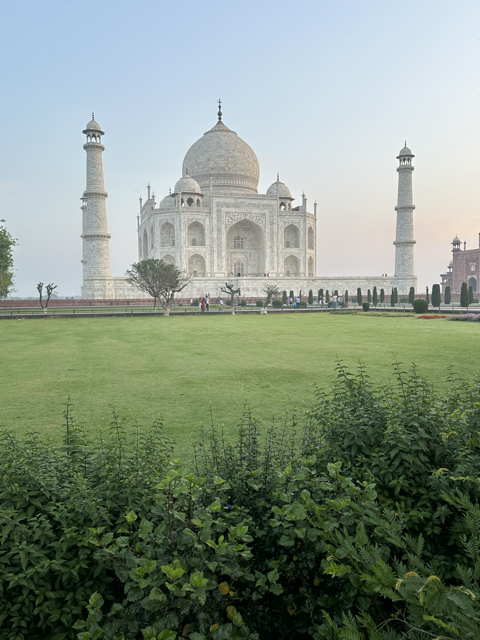
Our guide warned us about the swarms of other tourists and emphasized that the queues would soon get much, much worse. We went as quickly as we could after leaving our hotel lobby at 5:30 AM. As we walked around the broad, spacious gardens, swarms of other tourists from all over the world snapped pictures of this 400 year old mausoleum. I was reminded of Don DeLillo's "Most Photographed Barn in the World" from White Noise. I think the comparison is only half appropriate here, though. While it's true that this structure is a symbol which takes on more meaning because of its popularity, it has a deeper history and displays some true mastery of craft that is wholly unique to it. Precious marble from Rajasthan with intricate precious stone inlays on almost every surface.
To me, the most interesting thing about the Taj Mahal is its obsessive emphasis on symmetry. Shah Jahan, who commissioned the monument is both the author and destroy of this symmetry, the reason it is unable to be perfect. After his death, his daughters built a tomb for him beside the one he had originally designed for his wife. They sit side-by-side, but the balance within the structure is uneven as a result. Maybe there's a parable in here about the failure of children to understand their parents, or the impossibility of preserving your legacy after you're gone. I'm not sure.
Inevitably, as the guide spoke and my son began to process the information he was sharing, during a quiet moment as we sat on a bench he posed the question "Why did she die?" He was referring to the fact that the guide had repeatedly mentioned the death of Shah Jahan's favorite wife, Mumtaz, as the inspiration for the Taj Mahal. India's most prized monuments, it turns out — or at least the majority of sites that we saw during our brief trip, are all monuments to death left by empires long since fallen to ruin.
It's a very weird thing to be standing in front of a wonder of the world at 6:45 in the morning, sweating and bone tired after carrying a toddler around for over an hour, and hear yourself — or in this case, my wife — having to explain that everything dies at some point and that's okay. The key in these moments, I am beginning to learn, is to be honest but not overly dramatic. This is probably a conversation we'll have again with my son in a less grand setting.
Later, after we'd arrived back home in Mumbai, we asked our son what part of the trip had been his favorite. He told us it was the ride in the car between Agra and Delhi.
I'm referring to the fact that guides still take pains to emphasize the plans to build a Black Taj Mahal across the Yamuna river and that Shah Jahan died of a broken heart while looking at the Taj Mahal from Agra Fort.
<< all notes.